https://braintrust.dev
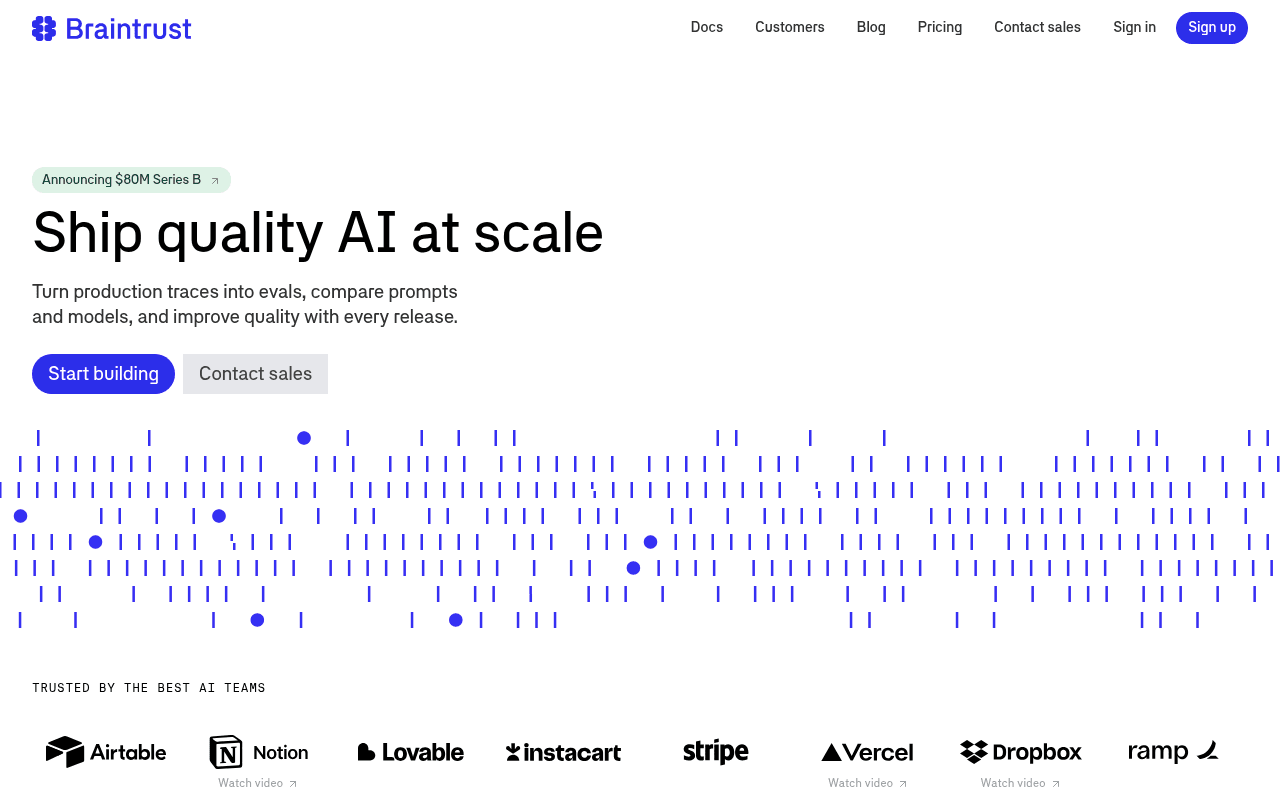
Screenshot of braintrust.dev
65of 100
C+

Braintrust has the logos, the funding badge, and a clean hero — but the abstract dot-matrix visualization below the fold does zero explanatory work, and the hero subhead buries the value prop in process language. The page sells workflow steps when it should be selling outcomes: fewer hallucinations in production, faster iteration cycles, and AI quality you can actually measure.

Your action plan

Ordered by conversion impact. Click any fix to see the before → after.

1
Replace abstract dot-matrix with product screenshot or demo GIF
High ImpactSome WorkFull-width dot/bar visualization below hero CTAs
Currently
Decorative animated dot pattern spanning full viewport width
Recommended
Show the actual trace inspection UI or eval comparison dashboard — a real product screenshot with a caption like 'Catch regressions before users do'
Nielsen Norman research shows product UI screenshots increase comprehension by 30%+ for technical tools; abstract visuals create cognitive load without communicating capability

Copy rewrites

Ready to use

Drop-in replacements for your highest-leverage text. Each rewrite explains the conversion principle behind it.

Ship quality AI at scale
Stop shipping AI that breaks in production
Pain-first framing creates immediate resonance; specificity beats aspiration for technical buyers evaluating a tool to solve a real problem
Turn production traces into evals, compare prompts and models, and improve quality with every release.
AI hallucinates, drifts, and regresses silently. Braintrust gives your team full observability — catch issues before users do, not after.
Problem-agitation-solution structure; names the specific fear (silent regression) that the target audience experiences daily
Start building
Start building
Start building free
Adding 'free' to the primary CTA removes the single biggest friction point for self-serve signups; reduces perceived risk and increases click-through
💡

The killer move

High Impact
Add a live eval score widget or interactive demo directly in the hero

For a developer-first tool, nothing converts like letting visitors run a real eval or see a live trace in the hero section — even a 60-second interactive sandbox would collapse the time-to-value gap and give engineers a reason to sign up before reading another word of copy.

How visitors experience your page

Second-by-second walkthrough.

2 strong3 mixed
0-3 secondsMixed
0-3s first impression: Logo, nav with Pricing and Sign up, $80M Series B badge, large headline, subhead, two CTAs, then abstract dot visualization
Funding badge builds credibility fast; headline is clear but generic. The dot visualization below CTAs creates visual noise that pulls attention away from conversion — visitor may scroll past CTAs prematurely
3-8 secondsStrong
3-8s value scan: Logo strip: Airtable, Notion, Stripe, Instacart, Vercel, Dropbox, Ramp — strong brand recognition
Logo quality is excellent for this audience; engineers recognize these as serious AI-forward companies. Trust spikes here, but there are no quotes or metrics to lock it in
8-15 secondsStrong
8-15s comprehension: 'AI fails differently than normal software' section with Observe-Evaluate-Improve loop diagram and three bullet features
This is the best copy on the page — specific, problem-aware, technically credible. Visitor who reaches here is likely to continue scrolling or click CTA
15-30 secondsMixed
15-30s feature evaluation: Observability and Evals feature sections with product UI screenshots, then Loop agent, Customizable trace views, Trace to dataset cards
Feature depth is good but the page becomes a feature list without tying back to business outcomes. Technical visitors stay engaged; product/business stakeholders may disengage here
30+ secondsMixed
30s+ decision: Brainstore database section with 23.9x, 2.55x, 3.73x performance metrics, then Secure by default compliance section
Performance numbers are compelling but lack context — 23.9x faster than what? Visitor reaching this point is likely evaluating seriously but needs a final CTA or case study link to convert

Health check

8 dimensions, weighted by conversion impact.

First impression & hero
20%
6/10
Strong funding badge and recognizable headline, but abstract dot visualization wastes prime real estate that should show the product
Copy & messaging
20%
7/10
'AI fails differently than normal software' is genuinely sharp; hero subhead is process-heavy and misses the emotional hook
Call-to-action
15%
6/10
Primary CTA is visible but lacks friction-reducing copy; dual equal-weight buttons create mild choice paralysis
Trust & social proof
15%
7/10
Tier-1 logo strip is excellent; absence of quotes, metrics, or case study snippets near the hero leaves trust half-built
Visual design & layout
10%
7/10
Clean, technically credible aesthetic with good use of dark sections for contrast; dot visualization is the one decorative misfire
Page structure & flow
8%
7/10
Logical progression from problem to solution to features to infrastructure; Brainstore section feels slightly disconnected from the main narrative
Technical & SEO signals
7%
6/10
LCP of 3.7s is above the 2.5s good threshold; 14 images missing alt text hurts accessibility and SEO; no meta description present
Differentiation & positioning
5%
7/10
'AI observability' category ownership is clear; Brainstore as proprietary database is a genuine differentiator that deserves more hero-level prominence

Page speed

Based on real Chrome user data
75/100
Overall score
Combined performance rating
3.7 s
Largest paint
Time until the main content is visible
0.02
Layout shift
How much the page moves while loading
1.5 s
First paint
Time until something first appears
198 ms
Responsiveness
How fast the page reacts to clicks

Want mobile analysis and fresh re-runs?

Buy roasts to unlock mobile analysis, re-analyze on demand, and more for braintrust.dev.

See roast packs →